It is snowing outside! I have lived in a mountain town for three years now, but I still get that jolt of excitement every time it snows. I still rush outside to catch flakes on my tongue and get filled with that crazy joy that only comes from thinking you’re going to get a day off school.
As I wait for the ski resorts to open, I have been scoping the internet the best snowboards for women for 2026 – and wondering if we need specific snowboards at all.
Is There a Difference Between Snowboards for Women and for Men?
With some frustration, I have noticed several sites which categorized boards in the following manner:
Powder Boards
All Mountain Boards
Freestyle Boards
Freeride Board
Beginner Boards
Women’s Boards.
As though we didn’t need all different kinds of gear! As if girls weren’t shredding the pow, careering down gullies and riding rails! It is frustrating that there are far less “women’s” boards available than men’s.
This raises the question, is there actually any difference between men’s snowboards and women’s snowboards? Or have they just given their boards the “shrink and pink” treatment so that they can attract new buyers?
Specific Boards for Specific Bodies

For a long time, snowboarding brands took a thoughtless approach to gear designed for female bodies. As cis-men made up the bulk of the outdoors industry, this was sadly true across the board: cis-women were an afterthought. This approach tends to become a self-fulfilling prophecy: by making women feel like secondary citizens of the slopes, they contributed to keeping the market for women’s boards smaller.
Anyway, snowboards of the 90s and the 00s were virulently sexist: men’s had half-naked women on, and women’s looked like a cupcake had thrown up on them. Men’s received the research budget and technology; women’s were shoddy copies covered in flowers.
The problem with this is that male and female bodies are not the same. Cis-women are, on average, lighter, smaller and have less muscle-mass than cis-men. We also have a lower centre of gravity. These differences make a difference to our movements while riding. For instance, when putting their weight onto one leg, females rotate their pelvis towards the weight-bearing limb, while males rotate in the opposite direction. This makes women more prone to knee injury.
Flex and Size
To compensate for this risk, women’s boards should have a greater flex than men’s. Since women are usually lighter, we also require shorter models. Our feet are smaller, so narrower boards are better.
Basically, there are a few, important differences, between men and women’s boards.
Does this mean that women shouldn’t buy men’s boards?
Absolutely not. If you find a board that fits you, give it a try! But it is worth taking into account the two factors of size and flex and making sure that the board isn’t too wide for your boot size.
Whenever possible, try out different boards to find the one that feels the most comfortable and responsive to you. Many resorts offer demo programs, allowing you to test various boards before making a purchase.
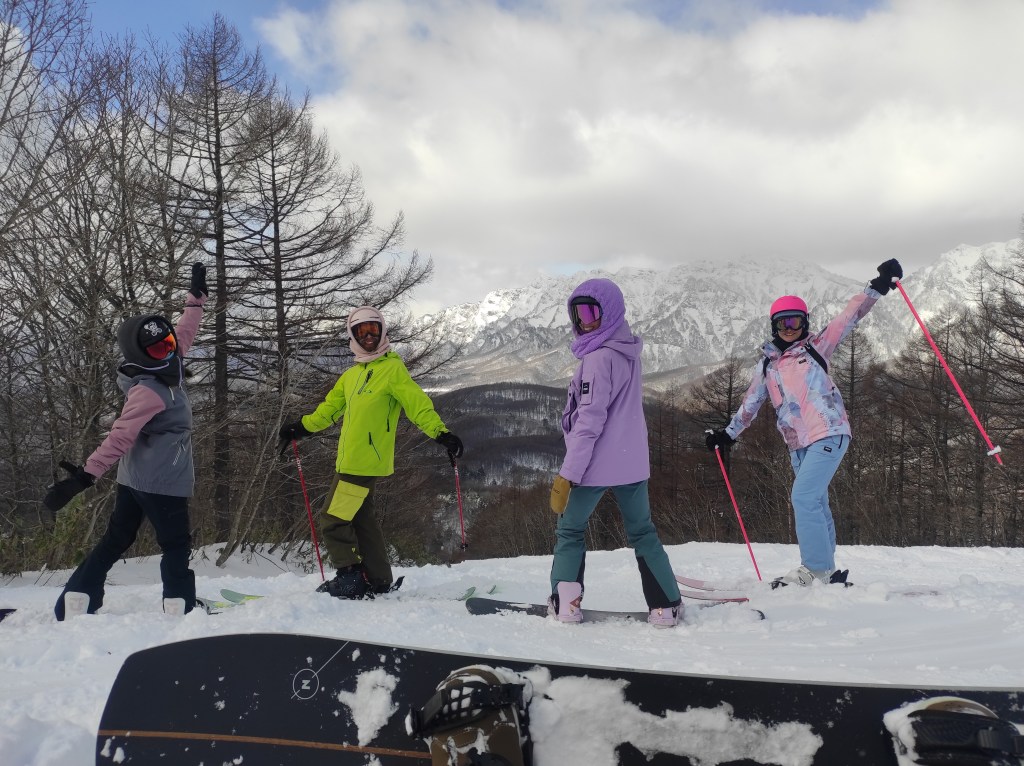
This winter season, I’m heading to Japan, and I’ll be riding a men’s Nitro Squash board. It’s a flex 7, while their women’s version is a 6. I’m interested to see how it will feel!
Update & Nitro Squash Review
I have now ridden the men’s Nitro Squash for two seasons. I love it, both for powder and piste. Because it is quite rigid, it grips ice or groomies really well. It actually made be enjoy piste riding for the first time ever. And it flies through powder, even the deep Japow.
The fact that it is a man’s board doesn’t disadvantage me at all, although I did feel it more severely when I changed my binding set up, leading to pain in my knees. It is quite a severe board, that requires some muscle, and turns my legs to goo after a few hours.
It is classed as an “advanced” board, which I didn’t really understand until I set it up in switch. With my non dominant leg, I am still very much a beginner, and the board was very hard to handle.
In conclusion: I recommend it to intermediate and advanced riders looking for a directional board.
Other articles you might enjoy:
 Shortcuts and Side Qests
Leave a comment